The best Starlink Mini battery monitor for iPhone
7 min read
If you're running Starlink Mini off a PeakDo Link-Power portable battery, you have two questions running constantly in the back of your head:how much battery is left, and how long until I lose Starlink. The answer to both lives on your battery's BLE chip — but only if your iPhone can read it.
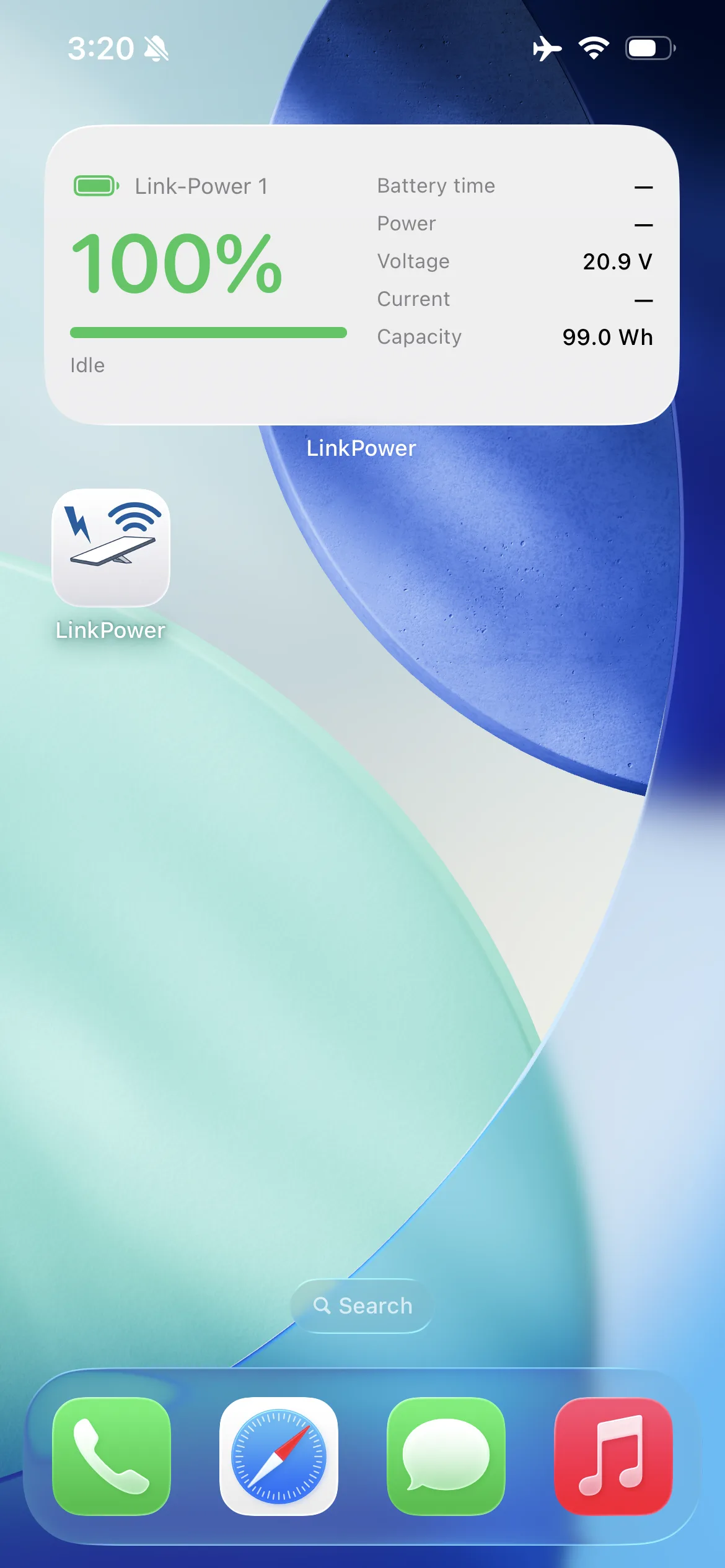
Link-Power Companion is the iOS app for that. Live battery telemetry, runtime estimates that update as Starlink's draw changes, Lock Screen widget, and the option to remotely toggle DC output if you need to power-cycle the dish without crawling around the van.
Why Starlink Mini owners end up here
Starlink Mini draws around 30W at idle and spikes higher when downloading or under load. The PeakDo Link-Power family is one of the few portable power stations that's small enough to bring on the road and still gives you several hours of runtime:
| Battery | Capacity | Approx Starlink runtime |
|---|---|---|
| Link-Power 1 (LP1) | 99Wh | ~3 hours |
| Link-Power 2 (LP2) | 153Wh | ~5–6 hours |
These are estimates. Real runtime depends on your draw, the ambient temperature, and how new the cells are. The point of having an app is you don't have to estimate — the battery itself reports the numbers and the app does the math.
What you want to see (and where to see it)
From most-glanceable to most-detailed:
Lock Screen widget — for your phone face-up on the dash
The widget shows level + runtime estimate + flow state. Color-coded green when charging from solar / AC, orange when Starlink is draining it. You don't unlock your phone to see whether the battery's holding steady; you just look.
Live Activity — for active travel days
When the app schedules a Live Activity, it sits on your Lock Screen and in the Dynamic Island while it's active. You see live wattage and time-to-full or time-remaining without entering the app at all.
Dashboard — for the deep dive
Open the app for the full picture: capacity, level, voltage, current, USB-C state, DC state, port temperature, runtime estimate. Updates are streamed from BLE notifications, not polled — so the numbers move as fast as your battery's firmware updates them, which is roughly once per second.
Power limits that protect Starlink
Starlink Mini ships with a 12V DC barrel cable, but you can also run it from USB-C PD at the right voltage. If you're running USB-C, the Link-Power lets you cap the output power so you don't accidentally exceed Starlink's spec.
From the app, head to Power Limits and set:
- Output limit — the maximum wattage the USB-C port will deliver. Set this conservatively (45W or 60W) for Starlink Mini.
- Runtime limit— optional. Auto-cuts power after a configured runtime so you don't accidentally drain the whole battery overnight.
Limits persist on the battery itself, so they're enforced whether or not your phone is connected.
Remote DC cycling — without leaving the front seat
Starlink Mini sometimes needs a power cycle when service drops. Normally you'd crawl back, unplug the barrel cable, plug it in again, wait. With Companion you tap DC Port → Off, wait 5 seconds, tap On. Done.
This is the kind of thing that's minor on day one and feels essential by day thirty.
Scheduled on/off — for solar-powered overnight setups
If you're running Starlink Mini off a Link-Power that recharges from a solar panel during the day, you probably want to notdrain the battery overnight when you're asleep and not using the internet.
Set a daily schedule: DC port on at 7am, DC port off at 11pm. The schedule runs on the device — your phone doesn't need to be in range when the timer fires. Detailed walkthrough in our DC port scheduling guide.
The honest comparison
I'm going to compare to the alternatives an iPhone Starlink Mini owner is realistically choosing between.
PeakDo Web App via Bluefy
The official PeakDo solution on iPhone. Read more in our guide to using PeakDo without Bluefy. Tl;dr: it works, but no Live Activities, no widgets, slow reconnection.
Starlink's own app
Shows Starlink status — connected, signal, throughput. Says nothing about your battery. Different problem.
Multimeter / clamp meter
Some folks measure wattage with an inline meter. Works, but no runtime estimate, no Lock Screen glance, no remote control. Use in addition, not instead.
Generic Bluetooth battery monitors (Renogy, Victron, etc.)
Excellent if you have a Renogy or Victron BMS. The PeakDo Link- Power has its own proprietary BLE protocol — you need a client that speaks it.
Setup: from unboxing to widget on Lock Screen
- Charge your Link-Power once before first use.
- Connect Starlink Mini via USB-C or DC barrel.
- Install Link-Power Companion from the App Store.
- Open the app and pair to your battery.
- Long-press your Lock Screen → Customize → Add Widgets → search Link-Power → pick the widget size.
- Optional: in app settings, enable Live Activities so they auto- start on extended sessions.
Total time: under five minutes if your iPhone is already on iOS 17.
The bottom line
Running Starlink Mini off a portable battery means you're constantly making decisions about power. The information to make those decisions exists — it's sitting on your battery's BLE chip — and getting it onto your iPhone Lock Screen takes one free app.
Frequently asked questions
How long does a PeakDo Link-Power 1 last with Starlink Mini?+
Roughly 3 hours of runtime. The LP1 is 99Wh and Starlink Mini draws ~30W at idle, more under load. Companion shows live runtime estimates that update as draw changes.
How long does the Link-Power 2 last with Starlink Mini?+
Roughly 5–6 hours. The LP2 is 153Wh, again at typical Starlink Mini draw. Faster recharge than LP1 too.
Does the app work while Starlink is using the battery?+
Yes. The app reads telemetry over Bluetooth, which doesn't conflict with the USB-C / DC output powering Starlink. You can monitor and adjust power limits live while Starlink is online.
Does this work for Starlink Standard or only Mini?+
It's specifically for the PeakDo Link-Power family, which PeakDo markets for Starlink Mini (the smaller dish). Starlink Standard draws ~50–75W and would need a much larger power station.